PORCELAIN PLATES.NET A Website for Porcelain License Plate Collectors & Enthusiasts |
North Carolina Archive
TOTAL KNOWN PORCELAIN VARIETIES: 129
I: PRE-STATES / CITY & COUNTY PLATES
With its first state issue not coming until
1913, North Carolina was late in issuing
official license plates compared with other
states in the Upper South. As a result,
beginning in 1909, when vehicles were first
required to be licensed, there was a long
pre-state period in which vehicle owners
were required to make their own plates or
commission others to make them on their
behalf. Numerous leather and even brass
plates have survived from this time period,
but there are also a number of surviving
examples of a pre-state porcelain plate that was manufactured by an unknown
firm and offered for sale to vehicle owners looking to display an attractive, well-
made plate. North Carolina expert Trent Culp believes these plates were offered
for sale in 1909 only before the company ceased producing them, perhaps due to
poor response. These simple black and white plates are small, are known to have
been issued in pairs as mandated by the General Assembly's 1909 Act, and appear
from surviving examples to have spanned a number range from at least 270 to
1249. They maintain a standard size and do not vary depending on the plate
number. Click on the thumbnail photo above to see a picture of #602 in use on a
car being driven in a parade.
In addition to the pre-state porcelain plate, various cities and counties within
North Carolina also experimented with local licensing. In fact, North Carolina
dwarfs all other states in terms of both the number of jurisdictions from which
porcelains are known, as well as the total number of porcelain varieties that have
been identified. However, not a single one of these falls within the pre-state era.
I will go into detail on these various plates below, but before doing so, I need to
address the For Hire plates that North Carolina counties issued between 1921-22
and 1925-26. There are 100 counties in the state today, just as there were in the
1920s. It appears that each county issued porcelain For Hire plates to taxis and
buses on an annual basis between 1921-22 and 1925-26. Each plate was good
from June 1 to May 31 of the following year. Notably, the plates were exactly the
same in any given year, regardless of the county of issue. In other words, all
1921-22 For Hire porcelains look identical in color, size, and layout, with the only
difference being the county name and the plate number. The same goes for each
of the successive four years. Thus, if we assume that all 100 counties issued
porcelains for these five years, then it is conceivable there are 500 different
plates to collect! There are plenty of holes which could conceivably all be filled in
one day as more and more missing years and counties turn up.
However, it should be pointed out that some of the smaller counties MAY not
have participated in this system of issuing For Hire plates. Potential evidence for
such an assertion lies in the fact that there are blank porcelains known from each
of the 5 years in the span. Some have argued that owners wishing to license
vehicles for hire in these small counties were issued these blanks and were
required to paint their county name and registration number onto the plate. New
York collector Gene Hauman owns a 1925-26 blank plate, and although the paint
has long since worn away, the remnants of the painted name "FRANKLIN
COUNTY" are clearly visible. Alternatively, perhaps these plates were in fact
issued in all years and counties and the blank plates are replacements for lost
tags. The truth remains to be discovered. Presently, plates from 30 of the 100
counties are known.
These For Hire plates are quite rare and no more than a handful of any specific
year and county are known to exist. Numbers are consistently small, appearing to
range from 1 to about 300. No one year appears to be especially rare or common
compared to the others. The maker of these plates remains a mystery. Is it
possible that their remarkable state-wide standardization indicates that the state
itself supplied counties with plates? This is yet another mystery in the fascinating
but murky world of porcelain license plates.
OTHER KNOWN CITY & COUNTY PORCELAIN PLATES:
In addition to the massive numbers of plates that were issued under this system
of For Hire plates between 1921-22 and 1925-26, as outlined above, there are
numerous other cities and counties within North Carolina that issued porcelains
of their own - both passenger and For Hire - that do not fall under the umbrella of
these standardized 1922-1926 plates, and which will be discussed below. Most of
these plates appear to be very random in size and layout with many unique
varieties having been issued in various jurisdictions. However, much like the
1921-22 to 1925-26 For Hire plates, there appears to be at least one other
standardized porcelain that was issued. This is a large black on yellow 1918-1919
For Hire plate. There are five known examples of this plate which do not vary by
county - with the exception of the plate number. Below is an accounting of these
and all other North Carolina city & county porcelains presently known.
ALAMANCE
The early history of Alamance County was dominated by the Sissipahaw, who lived
in the southern part of the county. As the years went on, Europeans entered the
region, largely following Native American trading paths. The colonial period for
the region was marked mostly by farming and trade. In 1849, the more industrial
western half of Orange County split off and became Alamance. During the 19th
century, the textile industry grew heavily in the area, and by the 1840s several
mills were set up along the Haw River. At the same time, the railroad was being
built through the area as a convenient link between Raleigh and Greensboro.
Typical of most counties in the South, Alamance County had a large slave
population, constituting roughly one-third of the residents on the eve of the Civil
War. After the war, Mills and textiles continued to provide jobs and fuel for the
Alamance economy through good times and bad. The only known porcelain city
plate from Alamance (aside from the 1922-1926 plates listed separately above) is a
single example of the standardized 1918-19 For Hire plates.
ANSON
Situated in the Charlotte-Gastonia metro area, Anson County lies in the South-
Central part of the state along the South Carolina border. For years, just one
surviving 1925-26 plate existed from the county, but in 2013, several additional
examples of this same year were unearthed.
CALDWELL
Caldwell County, carved from the counties of Burke and Wilkes, was formed in
January 1841. Situated in the northwest section of North Carolina in the foothills
of the Blue Ridge Mountains, the region was originally settled by the Catawba and
the Cherokee Native Americans. European settlers soon arrived and by 1790 the
area covered by present-day Caldwell County contained more than 2,500 people.
By the federal census of 1850, the population had surpassed 6,000 with an
economy based heavily on farming. One surviving example of a 1918-19 For Hire
porcelain is known to survive.
CONCORD
Located in Cabarrus County in central North Carolina, Concord really put itself on
the map around the turn of the 20th century, built on the success of large cotton
mills and a vibrant textile industry. By 1900, the population had swelled to 8,000
and by 1920, it neared 10,000. One surviving For Hire plate dated 1916-17 exists
today.
DAVIE
Formed in 1836, Davie is a county lying in the Winston-Salem metropolitan region
in the central portion of the state. A large 1918-19 For Hire plate made in the
standardized format for that year is known to exist.
GASTON
Gaston County is located in the South-Central Piedmont of North Carolina. Part of
the Charlotte Region, the county is situated on the border with South Carolina,
and is bounded on the east by the Catawba River and Mecklenburg County, and
on the west by Cleveland County. It’s 19th century history is marked by dozens of
distilleries that converted corn into whiskey. By mid-century, however, an
industrial boom hit the county and cotton milling flourished. The most common of
all locally-issued North Carolina porcelains hail from Gaston. These dated 1918
plates are small and rather simple, with perhaps 8-10 surviving examples
appearing to range from 1 to approximately 1500.
GUILFORD
Guilford is a county located in the north-central portion of the state. It is home to
the commercial hub of Greensboro. One of the standardized 1918-19 For Hire
plates survives from Guilford County.
HALIFAX
Formed in 1758 from Edgecombe County, Halifax lies in the northeastern part of
the state just south of the Virginia border. The county seat, also named Halifax,
had been established in 1757 on the Roanoke River. Located on the fall line of
the Piedmont and Coastal Plain, the county has an interesting mixture of flat and
hilly terrain and an excellent climate for agricultural pursuits. The original
residents of this area were the Tuscarora Native Americans. There is one
surviving example of a standardized 1918-19 For Hire plate known from Halifax.
LUMBERTON
The County Seat of Robeson County, Lumberton is located in southern North
Carolina's Inner Banks region, and lies on the Lumber River. Founded in 1787,
Lumberton was originally a shipping point for lumber used by the navy, which was
sent downriver to Georgetown, South Carolina. City plates were apparently
issued from at least 1916-17 through 1920-21, and there are five varieties known
within this span, one of which is a For Hire plate from 1917-18. A number of
Lumberton plates surfaced in the early 2000s, when a group was dug up along a
North Carolina river bank.
MOORE
Formed in 1784, Moore is a county in central North Carolina. Two surviving
examples of a 1918-19 For Hire plate in the standardized yellow and black format
exist from Moore.
RALEIGH
Raleigh is the capital city of the State of North Carolina and the county seat of
Wake County. It is located in the central region of the state, where the piedmont
and the coastal plains regions meet. Despite being spared destruction in the Civil
War, Raleigh grew very little from its original 1792 size until the introduction of
streetcar lines in the 1920s, which soon launched the city into prominence as the
commercial center of the Eastern portion of the state. In 1910, the city’s
population neared 20,000 and in 1920 it was around 25,000. There are an amazing
thirteen different varieties of porcelain plates known from Raleigh - by far the
most different issues known from any given jurisdiction in the state. These
plates are the earliest known locally-issued porcelains in North Carolina, and date
from at least 1914 through 1919. The known plates include passenger issues,
One Horse Hacks, a Public Dray, and a couple of For Hire plates. The 1914-15
issues, interestingly, expire on May 30th, while all succeeding issues expire on
the 31st. Notably, there are two distinct variants of the passenger version of the
1914-15 plates - one blue and one orange. We have no idea what the difference
between these two plates is. By 1919, the numbers on passenger issues are
known to have neared the 700 mark. Beginning in 1919-20, Raleigh plates were
manufactured of painted metal, ending a run of at least 5 years of annual
porcelain issues.
SALISBURY
The county seat of Rowan County, Salisbury lies in the Piedmont and was the site
of a Confederate prison during the Civil War. There are four different varieties of
Salisbury porcelains known, dating from 1914-15 through 1917-18. The later three
issues are in an unusual elongated style with numbers reaching nearly 400 by
1918. Oddly enough, the 1914-15 and the 1917-18 plates show a May 30th
expiration, rather than the typical May 31st expiration on so many other North
Carolina city & county plates. Why would a plate be designed to expire one day
before the month's end? Perhaps this was an error by the manufacturer.
STANLY
Formed in 1841, Stanly is a county in the central portion of North Carolina. A
standard 1918-19 For Hire plate is known from Stanly County.
TARBORO
This plate was dug up in Tarboro, which is a city in Edgecombe County east of
Raleigh. While I can't guarantee that this plate was actually issued in Tarboro, I
am virtually certain it is from North Carolina considering its place of discovery,
combined with North Carolina's long history of For Hire plates from various
jurisdictions.
TYRRELL
Located on the south shore of Albemarle Sound, Tyrrell County was formed in
1729 from Chowan, Bertie, Currituck and Pasquotank counties. While settlers
from Virginia streamed southward into the Albemarle region during the early
eighteenth century, the development of Tyrrell County proceeded slowly due to
the swamp forest and vast wetlands of muck-peat, pocosins, and pines that
restricted the penetration of the interior. Consequently, the county was one of
the most isolated and sparsely populated parts of the state. In 1840, there were
4,448 inhabitants in Tyrrell and even in the mid 20th century, the population
peaked at just over 5,000. There is one known example of the standardized 1918-
19 For Hire plates known from Tyrrell.
WAKE
Formed in 1771, Wake is a county in central North Carolina. The state capital of
Raleigh is the county seat. Two varieties of For Hire plates in the 1916-1919
range are known from Wake County in a standardized 4" x 9" format. These give
every appearance of being in the same style and format as the Raleigh plates
from the same era, and were surely manufactured by the same company.
Interestingly, by at least 1921-22, Wake County For Hire plates were no longer
porcelain, instead being constructed of embossed metal.
WARREN
The county of Warren lies along the state’s northern border with Virginia. There
is one surviving example of a standard-issue 1918-19 For Hire plate known from
Warren.
WILSON
Incorporated in 1849, the city of Wilson grew in size and importance and was soon
chosen as the county seat of the newly created Wilson County. At this time, the
railroad in Wilson County provided access to the port of Wilmington and cultural
center of Richmond. The city and county prospered as a trading center at the
heart of this vital railroad line. Following the Civil War, farmers turned from
cotton to tobacco, a crop perfectly adapted to the region's sandy soil. Merchants
seized the opportunities that the new crop provided, and by the early 20th
century, Wilson had become the world's largest bright leaf tobacco market. The
city appears to have begun issuing porcelain vehicle licenses sometime prior to
1925. A single undated plate is the earliest known example. This issue appears
to have been followed by dated plates beginning in at least 1923. In 1926, the city
changed from a fairly simple blue and white plate to one of the most distinctive
license plate formats ever conceived of. From 1925-26 through 1930-31, the city
of Wilson issued license plates that served not only to register vehicles but to
highlight the prosperity of Wilson with what amounted to an advertisement.
These large, attractive plates bore a large tobacco leaf and boasted four different
colors of porcelain. Across the center of the plate, nearly obscuring the lightly
colored registration number, the town's motto was emblazoned: "Largest Tobacco
Market in the World."
WINSTON-SALEM
Winston-Salem is a city in Forsyth County, in the Piedmont region of North
Carolina. In 1889, the United States Postal Service combined the mail offices for
the two towns of Winston and Salem, and the towns were officially joined as
"Winston-Salem" in 1913, the same year that the state of North Carolina first
began issuing plates. There are two surviving examples of porcelain license
plates from Winston-Salem, one undated and the other expiring in June of 1918.
These plates are both designed as toppers with slots on the bottom only, but are
clearly vehicle licenses as they are numbered.
II: STATE-ISSUED PASSENGER PLATES
In March of 1913, the North Carolina General Assembly updated their vehicle
registration regulations, and decided to issue official North Carolina state plates.
Interestingly, these first dated 1913 plates were only intended for new
registrants, and owners re-registering their vehicles were allowed to keep their
pre-state plates. Furthermore, first valid on April 1 and expiring June 30, the 1913
plates were only in use for three months. Coupled with the fact that they were
issued as singles only, it becomes clear why they are among the rarest state-
issued porcelain license plates there is, with just over 30 examples known in
collectors’ hands, as reported by Roger C. Haynes. This number includes a hoard
of about 8 examples that surfaced in 2014 in very poor condition. When the 1913
plates were issued, North Carolina registrations were running around the 6,800
mark, so that is approximately where the first issue numbers began. The contract
for these plates was granted to the Baltimore Enamel & Sign Company which
seems to have produced plates running up to probably 7800.
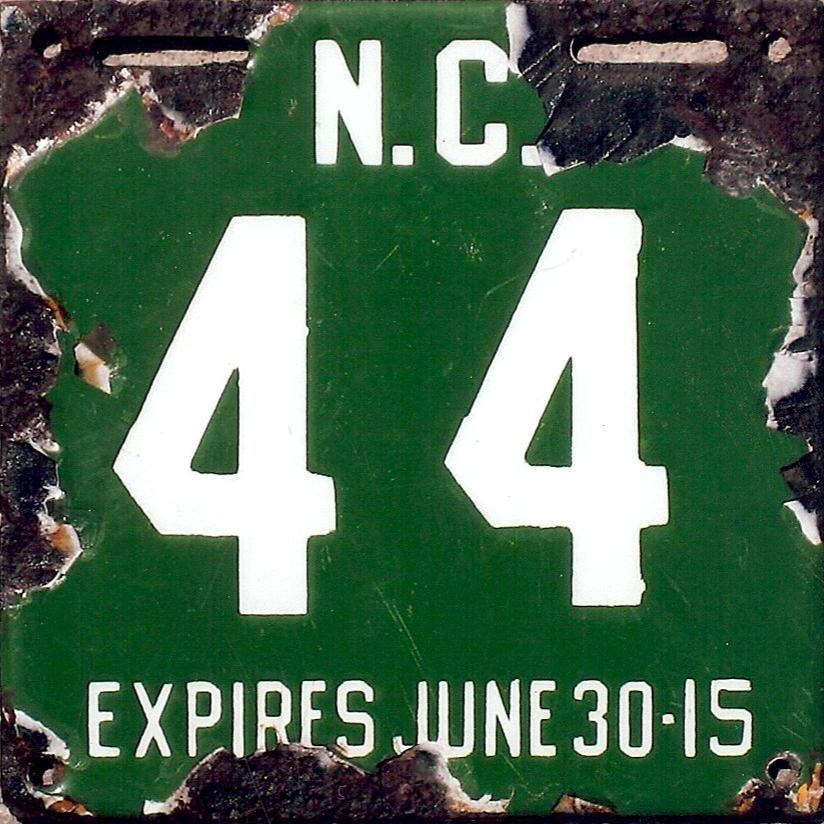
Annual dated porcelain plates continued for the next three years, through 1916.
Like the 1913, each was good from July 1 – June 30. Beginning with the 1913-14
second issue, all vehicles were re-registered and over the course of the year,
numbers surpassed the 10,000 mark. With this milestone, a larger base was
issued to accommodate the higher number, thus resulting in two varying lengths
of plates. The green 1914-15 plates reached nearly 18,000 and the gray 1915-16
issue exceeded 26,000 before all was said and done, although it is notable that
the Lumberton "Robesonian" reported that only 16,305 1914-15 automobile
licenses were issued and the "Statesville Landmark" reported that only 24,460
1915-16 licenses were issued. These final porcelain issues – expiring in June of
1916 – were one-half inch less tall, and were manufactured of a much thinner
metal and are notorious for their propensity to chip. The higher-numbered 1915-
16 plates do not have the maker’s mark on the reverse.
III: STATE-ISSUED NON-PASSENGER PLATES
BUS
An undated porcelain plate is known with a prefix designation “BUS,” but it is
unknown what this plate was used for. It is in a completely different format from
any other North Carolina porcelain, except that it is red on white, leading some to
presume it is a 1913-14 issue.
DEALER
Dealer plates were first issued in 1913-14. These were issued in the same color
and format as the passenger plates, except that they bore the designation
“Dealer” across the top between the bolt slots. These 1913-14 Dealer plates are
exceedingly rare and I have only ever heard of four or five of them in collectors'
hands. For 1914-15 and 1915-16, the word dealer was dropped in favor of a
simple “D” prefix followed by a dash and then the plate number.
MOTORCYCLE
Small, square motorcycle plates were also issued beginning in 1913-14 and were
the same colors as the passenger and dealer issues. These plates are the only
examples of state-issued porcelain license plates from anywhere to have been
manufactured in a square shape. Exceptionally rare, the most common of these
plates is the 1914-15 issue, of which there are perhaps a half dozen known.
FURTHER READING
Robesonian (Lumberton, NC), October 12, 1914; July 26, 1915; December 13, 1915
Statesville Landmark, July 31, 1914; July 11, 1916
Roger C. Haynes, “First In Freedom – North Carolina.” ALPCA Newsletter, 27, 3
(June, 1981), p. 43.
Roger C. Haynes, “North Carolina: Tarheel Tag Heaven.” PLATES, 51, 3 (June,
2005), pp. 26-28.
I: PRE-STATES / CITY & COUNTY PLATES
With its first state issue not coming until
1913, North Carolina was late in issuing
official license plates compared with other
states in the Upper South. As a result,
beginning in 1909, when vehicles were first
required to be licensed, there was a long
pre-state period in which vehicle owners
were required to make their own plates or
commission others to make them on their
behalf. Numerous leather and even brass
plates have survived from this time period,
but there are also a number of surviving
examples of a pre-state porcelain plate that was manufactured by an unknown
firm and offered for sale to vehicle owners looking to display an attractive, well-
made plate. North Carolina expert Trent Culp believes these plates were offered
for sale in 1909 only before the company ceased producing them, perhaps due to
poor response. These simple black and white plates are small, are known to have
been issued in pairs as mandated by the General Assembly's 1909 Act, and appear
from surviving examples to have spanned a number range from at least 270 to
1249. They maintain a standard size and do not vary depending on the plate
number. Click on the thumbnail photo above to see a picture of #602 in use on a
car being driven in a parade.
In addition to the pre-state porcelain plate, various cities and counties within
North Carolina also experimented with local licensing. In fact, North Carolina
dwarfs all other states in terms of both the number of jurisdictions from which
porcelains are known, as well as the total number of porcelain varieties that have
been identified. However, not a single one of these falls within the pre-state era.
I will go into detail on these various plates below, but before doing so, I need to
address the For Hire plates that North Carolina counties issued between 1921-22
and 1925-26. There are 100 counties in the state today, just as there were in the
1920s. It appears that each county issued porcelain For Hire plates to taxis and
buses on an annual basis between 1921-22 and 1925-26. Each plate was good
from June 1 to May 31 of the following year. Notably, the plates were exactly the
same in any given year, regardless of the county of issue. In other words, all
1921-22 For Hire porcelains look identical in color, size, and layout, with the only
difference being the county name and the plate number. The same goes for each
of the successive four years. Thus, if we assume that all 100 counties issued
porcelains for these five years, then it is conceivable there are 500 different
plates to collect! There are plenty of holes which could conceivably all be filled in
one day as more and more missing years and counties turn up.
However, it should be pointed out that some of the smaller counties MAY not
have participated in this system of issuing For Hire plates. Potential evidence for
such an assertion lies in the fact that there are blank porcelains known from each
of the 5 years in the span. Some have argued that owners wishing to license
vehicles for hire in these small counties were issued these blanks and were
required to paint their county name and registration number onto the plate. New
York collector Gene Hauman owns a 1925-26 blank plate, and although the paint
has long since worn away, the remnants of the painted name "FRANKLIN
COUNTY" are clearly visible. Alternatively, perhaps these plates were in fact
issued in all years and counties and the blank plates are replacements for lost
tags. The truth remains to be discovered. Presently, plates from 30 of the 100
counties are known.
These For Hire plates are quite rare and no more than a handful of any specific
year and county are known to exist. Numbers are consistently small, appearing to
range from 1 to about 300. No one year appears to be especially rare or common
compared to the others. The maker of these plates remains a mystery. Is it
possible that their remarkable state-wide standardization indicates that the state
itself supplied counties with plates? This is yet another mystery in the fascinating
but murky world of porcelain license plates.
OTHER KNOWN CITY & COUNTY PORCELAIN PLATES:
In addition to the massive numbers of plates that were issued under this system
of For Hire plates between 1921-22 and 1925-26, as outlined above, there are
numerous other cities and counties within North Carolina that issued porcelains
of their own - both passenger and For Hire - that do not fall under the umbrella of
these standardized 1922-1926 plates, and which will be discussed below. Most of
these plates appear to be very random in size and layout with many unique
varieties having been issued in various jurisdictions. However, much like the
1921-22 to 1925-26 For Hire plates, there appears to be at least one other
standardized porcelain that was issued. This is a large black on yellow 1918-1919
For Hire plate. There are five known examples of this plate which do not vary by
county - with the exception of the plate number. Below is an accounting of these
and all other North Carolina city & county porcelains presently known.
ALAMANCE
The early history of Alamance County was dominated by the Sissipahaw, who lived
in the southern part of the county. As the years went on, Europeans entered the
region, largely following Native American trading paths. The colonial period for
the region was marked mostly by farming and trade. In 1849, the more industrial
western half of Orange County split off and became Alamance. During the 19th
century, the textile industry grew heavily in the area, and by the 1840s several
mills were set up along the Haw River. At the same time, the railroad was being
built through the area as a convenient link between Raleigh and Greensboro.
Typical of most counties in the South, Alamance County had a large slave
population, constituting roughly one-third of the residents on the eve of the Civil
War. After the war, Mills and textiles continued to provide jobs and fuel for the
Alamance economy through good times and bad. The only known porcelain city
plate from Alamance (aside from the 1922-1926 plates listed separately above) is a
single example of the standardized 1918-19 For Hire plates.
ANSON
Situated in the Charlotte-Gastonia metro area, Anson County lies in the South-
Central part of the state along the South Carolina border. For years, just one
surviving 1925-26 plate existed from the county, but in 2013, several additional
examples of this same year were unearthed.
CALDWELL
Caldwell County, carved from the counties of Burke and Wilkes, was formed in
January 1841. Situated in the northwest section of North Carolina in the foothills
of the Blue Ridge Mountains, the region was originally settled by the Catawba and
the Cherokee Native Americans. European settlers soon arrived and by 1790 the
area covered by present-day Caldwell County contained more than 2,500 people.
By the federal census of 1850, the population had surpassed 6,000 with an
economy based heavily on farming. One surviving example of a 1918-19 For Hire
porcelain is known to survive.
CONCORD
Located in Cabarrus County in central North Carolina, Concord really put itself on
the map around the turn of the 20th century, built on the success of large cotton
mills and a vibrant textile industry. By 1900, the population had swelled to 8,000
and by 1920, it neared 10,000. One surviving For Hire plate dated 1916-17 exists
today.
DAVIE
Formed in 1836, Davie is a county lying in the Winston-Salem metropolitan region
in the central portion of the state. A large 1918-19 For Hire plate made in the
standardized format for that year is known to exist.
GASTON
Gaston County is located in the South-Central Piedmont of North Carolina. Part of
the Charlotte Region, the county is situated on the border with South Carolina,
and is bounded on the east by the Catawba River and Mecklenburg County, and
on the west by Cleveland County. It’s 19th century history is marked by dozens of
distilleries that converted corn into whiskey. By mid-century, however, an
industrial boom hit the county and cotton milling flourished. The most common of
all locally-issued North Carolina porcelains hail from Gaston. These dated 1918
plates are small and rather simple, with perhaps 8-10 surviving examples
appearing to range from 1 to approximately 1500.
GUILFORD
Guilford is a county located in the north-central portion of the state. It is home to
the commercial hub of Greensboro. One of the standardized 1918-19 For Hire
plates survives from Guilford County.
HALIFAX
Formed in 1758 from Edgecombe County, Halifax lies in the northeastern part of
the state just south of the Virginia border. The county seat, also named Halifax,
had been established in 1757 on the Roanoke River. Located on the fall line of
the Piedmont and Coastal Plain, the county has an interesting mixture of flat and
hilly terrain and an excellent climate for agricultural pursuits. The original
residents of this area were the Tuscarora Native Americans. There is one
surviving example of a standardized 1918-19 For Hire plate known from Halifax.
LUMBERTON
The County Seat of Robeson County, Lumberton is located in southern North
Carolina's Inner Banks region, and lies on the Lumber River. Founded in 1787,
Lumberton was originally a shipping point for lumber used by the navy, which was
sent downriver to Georgetown, South Carolina. City plates were apparently
issued from at least 1916-17 through 1920-21, and there are five varieties known
within this span, one of which is a For Hire plate from 1917-18. A number of
Lumberton plates surfaced in the early 2000s, when a group was dug up along a
North Carolina river bank.
MOORE
Formed in 1784, Moore is a county in central North Carolina. Two surviving
examples of a 1918-19 For Hire plate in the standardized yellow and black format
exist from Moore.
RALEIGH
Raleigh is the capital city of the State of North Carolina and the county seat of
Wake County. It is located in the central region of the state, where the piedmont
and the coastal plains regions meet. Despite being spared destruction in the Civil
War, Raleigh grew very little from its original 1792 size until the introduction of
streetcar lines in the 1920s, which soon launched the city into prominence as the
commercial center of the Eastern portion of the state. In 1910, the city’s
population neared 20,000 and in 1920 it was around 25,000. There are an amazing
thirteen different varieties of porcelain plates known from Raleigh - by far the
most different issues known from any given jurisdiction in the state. These
plates are the earliest known locally-issued porcelains in North Carolina, and date
from at least 1914 through 1919. The known plates include passenger issues,
One Horse Hacks, a Public Dray, and a couple of For Hire plates. The 1914-15
issues, interestingly, expire on May 30th, while all succeeding issues expire on
the 31st. Notably, there are two distinct variants of the passenger version of the
1914-15 plates - one blue and one orange. We have no idea what the difference
between these two plates is. By 1919, the numbers on passenger issues are
known to have neared the 700 mark. Beginning in 1919-20, Raleigh plates were
manufactured of painted metal, ending a run of at least 5 years of annual
porcelain issues.
SALISBURY
The county seat of Rowan County, Salisbury lies in the Piedmont and was the site
of a Confederate prison during the Civil War. There are four different varieties of
Salisbury porcelains known, dating from 1914-15 through 1917-18. The later three
issues are in an unusual elongated style with numbers reaching nearly 400 by
1918. Oddly enough, the 1914-15 and the 1917-18 plates show a May 30th
expiration, rather than the typical May 31st expiration on so many other North
Carolina city & county plates. Why would a plate be designed to expire one day
before the month's end? Perhaps this was an error by the manufacturer.
STANLY
Formed in 1841, Stanly is a county in the central portion of North Carolina. A
standard 1918-19 For Hire plate is known from Stanly County.
TARBORO
This plate was dug up in Tarboro, which is a city in Edgecombe County east of
Raleigh. While I can't guarantee that this plate was actually issued in Tarboro, I
am virtually certain it is from North Carolina considering its place of discovery,
combined with North Carolina's long history of For Hire plates from various
jurisdictions.
TYRRELL
Located on the south shore of Albemarle Sound, Tyrrell County was formed in
1729 from Chowan, Bertie, Currituck and Pasquotank counties. While settlers
from Virginia streamed southward into the Albemarle region during the early
eighteenth century, the development of Tyrrell County proceeded slowly due to
the swamp forest and vast wetlands of muck-peat, pocosins, and pines that
restricted the penetration of the interior. Consequently, the county was one of
the most isolated and sparsely populated parts of the state. In 1840, there were
4,448 inhabitants in Tyrrell and even in the mid 20th century, the population
peaked at just over 5,000. There is one known example of the standardized 1918-
19 For Hire plates known from Tyrrell.
WAKE
Formed in 1771, Wake is a county in central North Carolina. The state capital of
Raleigh is the county seat. Two varieties of For Hire plates in the 1916-1919
range are known from Wake County in a standardized 4" x 9" format. These give
every appearance of being in the same style and format as the Raleigh plates
from the same era, and were surely manufactured by the same company.
Interestingly, by at least 1921-22, Wake County For Hire plates were no longer
porcelain, instead being constructed of embossed metal.
WARREN
The county of Warren lies along the state’s northern border with Virginia. There
is one surviving example of a standard-issue 1918-19 For Hire plate known from
Warren.
WILSON
Incorporated in 1849, the city of Wilson grew in size and importance and was soon
chosen as the county seat of the newly created Wilson County. At this time, the
railroad in Wilson County provided access to the port of Wilmington and cultural
center of Richmond. The city and county prospered as a trading center at the
heart of this vital railroad line. Following the Civil War, farmers turned from
cotton to tobacco, a crop perfectly adapted to the region's sandy soil. Merchants
seized the opportunities that the new crop provided, and by the early 20th
century, Wilson had become the world's largest bright leaf tobacco market. The
city appears to have begun issuing porcelain vehicle licenses sometime prior to
1925. A single undated plate is the earliest known example. This issue appears
to have been followed by dated plates beginning in at least 1923. In 1926, the city
changed from a fairly simple blue and white plate to one of the most distinctive
license plate formats ever conceived of. From 1925-26 through 1930-31, the city
of Wilson issued license plates that served not only to register vehicles but to
highlight the prosperity of Wilson with what amounted to an advertisement.
These large, attractive plates bore a large tobacco leaf and boasted four different
colors of porcelain. Across the center of the plate, nearly obscuring the lightly
colored registration number, the town's motto was emblazoned: "Largest Tobacco
Market in the World."
WINSTON-SALEM
Winston-Salem is a city in Forsyth County, in the Piedmont region of North
Carolina. In 1889, the United States Postal Service combined the mail offices for
the two towns of Winston and Salem, and the towns were officially joined as
"Winston-Salem" in 1913, the same year that the state of North Carolina first
began issuing plates. There are two surviving examples of porcelain license
plates from Winston-Salem, one undated and the other expiring in June of 1918.
These plates are both designed as toppers with slots on the bottom only, but are
clearly vehicle licenses as they are numbered.
II: STATE-ISSUED PASSENGER PLATES
In March of 1913, the North Carolina General Assembly updated their vehicle
registration regulations, and decided to issue official North Carolina state plates.
Interestingly, these first dated 1913 plates were only intended for new
registrants, and owners re-registering their vehicles were allowed to keep their
pre-state plates. Furthermore, first valid on April 1 and expiring June 30, the 1913
plates were only in use for three months. Coupled with the fact that they were
issued as singles only, it becomes clear why they are among the rarest state-
issued porcelain license plates there is, with just over 30 examples known in
collectors’ hands, as reported by Roger C. Haynes. This number includes a hoard
of about 8 examples that surfaced in 2014 in very poor condition. When the 1913
plates were issued, North Carolina registrations were running around the 6,800
mark, so that is approximately where the first issue numbers began. The contract
for these plates was granted to the Baltimore Enamel & Sign Company which
seems to have produced plates running up to probably 7800.
Annual dated porcelain plates continued for the next three years, through 1916.
Like the 1913, each was good from July 1 – June 30. Beginning with the 1913-14
second issue, all vehicles were re-registered and over the course of the year,
numbers surpassed the 10,000 mark. With this milestone, a larger base was
issued to accommodate the higher number, thus resulting in two varying lengths
of plates. The green 1914-15 plates reached nearly 18,000 and the gray 1915-16
issue exceeded 26,000 before all was said and done, although it is notable that
the Lumberton "Robesonian" reported that only 16,305 1914-15 automobile
licenses were issued and the "Statesville Landmark" reported that only 24,460
1915-16 licenses were issued. These final porcelain issues – expiring in June of
1916 – were one-half inch less tall, and were manufactured of a much thinner
metal and are notorious for their propensity to chip. The higher-numbered 1915-
16 plates do not have the maker’s mark on the reverse.
III: STATE-ISSUED NON-PASSENGER PLATES
BUS
An undated porcelain plate is known with a prefix designation “BUS,” but it is
unknown what this plate was used for. It is in a completely different format from
any other North Carolina porcelain, except that it is red on white, leading some to
presume it is a 1913-14 issue.
DEALER
Dealer plates were first issued in 1913-14. These were issued in the same color
and format as the passenger plates, except that they bore the designation
“Dealer” across the top between the bolt slots. These 1913-14 Dealer plates are
exceedingly rare and I have only ever heard of four or five of them in collectors'
hands. For 1914-15 and 1915-16, the word dealer was dropped in favor of a
simple “D” prefix followed by a dash and then the plate number.
MOTORCYCLE
Small, square motorcycle plates were also issued beginning in 1913-14 and were
the same colors as the passenger and dealer issues. These plates are the only
examples of state-issued porcelain license plates from anywhere to have been
manufactured in a square shape. Exceptionally rare, the most common of these
plates is the 1914-15 issue, of which there are perhaps a half dozen known.
FURTHER READING
Robesonian (Lumberton, NC), October 12, 1914; July 26, 1915; December 13, 1915
Statesville Landmark, July 31, 1914; July 11, 1916
Roger C. Haynes, “First In Freedom – North Carolina.” ALPCA Newsletter, 27, 3
(June, 1981), p. 43.
Roger C. Haynes, “North Carolina: Tarheel Tag Heaven.” PLATES, 51, 3 (June,
2005), pp. 26-28.
 |
| |
 |
| |
 |
| |
 |
| |
 |
| |
 |
| |
 |
|


| North Carolina Pre-State |
|
|
|
|
|
|
|
|
|
|
|
|
|
|


| |||||||||||||||||||||||||
|
|
|




|


|

| This Wake County 1921-22 plate is interesting because it is a county-issued embossed metal For Hire plate from one of the five years that county-issued For Hire plates were supposed to made of porcelain. Does the existence of this plate mean that Wake County somehow opted out of the standardized For Hire plates that were used from 1921-22 through 1925-26? |


| After at least five years of annual porcelain issues, the city of Raleigh switched first to flat painted metal and then to embossed metal as their material of choice for license plates |
|
|


|

