PORCELAIN PLATES.NET A Website for Porcelain License Plate Collectors & Enthusiasts |
California Archive - Part 1
TOTAL KNOWN PORCELAIN VARIETIES: 68
I: PRE-STATES / CITY & COUNTY PLATES
California has a very rich history of porcelain pre-states, boasting some of the
most attractive and unique porcelains ever produced in any state. Although
California first required license plates to be used in 1905, all known varieties
over the first four years are made of metal, leather, wood, and other such
materials. As per the 1905 ordinance, plates were only required on the rear of
the car, although sometimes owners decided to put one on the front as well. As
California plate historian Jeff Minard has discovered, the switch to porcelain
seems to have occurred in 1909, when the Automobile Club of Southern
California, responding to growing pressure to force motorists to display plates on
the front as well as the rear of their vehicles, offered members porcelain Auto
Club “hangars” for their cars, loaning each of the Club’s 1,000 members free
plates. Interestingly, as indicated in paperwork enclosed in the shipment of
these plates, owners were told that these plates were the property of the Auto
Club and that if the motorist ceased to be a member, then the plates were to be
returned. Incidentally, it appears that some owners cut off the Auto Club
insignias - perhaps after dropping membership - leaving behind plates that are
often mistaken for simple rectangular pre-states. Auto Club plates for new 1909
registrants began around 20,000. Of course, lower numbers are known as well,
because the Auto Club provided whatever number a vehicle had registered to it.
For someone looking to have a pretty porcelain plate made to replace their
tattered leather plate from years earlier, they got a porcelain with that same
number, be it from 1905, 1906, or whatever. Between mid-1909 and the end of
the pre-state era in 1913, perhaps 4,000 Auto Club plates of all varieties were
manufactured. These plates carried the emblem of both the Auto Club of
Southern California, as well as the American Automobile Association. It is not
clear who manufactured these plates, but we know that at least some were made
by the California Metal Enameling Company and bear that company's paper label
on the reverse. It is also believed that the Pacific Sign & Enamel Company may
have produced some porcelain pre-states.
The Auto Club porcelains come with
various subtle differences, but can be
essentially broken down into eight
collectible varieties. The first three
concern the state’s famous and elaborate
“Mickey Mouse” plates, as they have
come to be known among collectors.
These plates have the Auto Club and Auto
Association emblems at the top. At some
point in the mid-80,000s, it is notable that
the numerals were altered to be thinner,
perhaps in order to accommodate the
six-digit plates which would soon be
arriving. The presence of low-numbered
plates with thin numerals would indicate
that they were replacement plates. A
substantially rarer variant has the "ears" on the bottom and itself comes in two
different formats. There are only two of these inverted plates known - one a five
digit and the other a six digit plate. There are at least two high-numbered Mickey
Mouse porcelains labeled on the reverse by the California Metal Enameling
Company. In fact, the numbers of these plates are the highest numbered Mickey
Mouse plates ever seen. Thus, we know that California Metal was producing at
least some of these plates in 1913, if not earlier as well.
The other five varieties concern the long and short versions of the “Dogbone”
porcelains, so known because they carried the Club emblems on the ends, as
opposed to the top or bottom. Specialists see even further subtle differences,
such as the presence of some dogbone plates with bolt holes, others with slots,
and still others with neither slots nor holes, but these are not generally
considered distinct types. The most unusual version of the “Dogbone” plates are
notable for having a flanged edge along the top and bottom. Some of these
flanged plates had black lettering, but the vast majority were manufactured with
blue letters and numbers. This makes them very distinct, as all other varieties of
Auto Club porcelains are black & white. Even more interesting, the blue & white
flanged plates come in two very distinct types - a long version with the right
circle bearing the term "Auto Ass'n" and a smaller version bearing the term "Auto
Ass."
The final two Dogbone types are the black
& white flat versions - a very long 24"
version and a relatively smaller 17 3/4"
variant which is further distinguished by
the fact that the "CAL" designation is
vertical rather than horizontal. As with all
Auto Club porcelains, some of these plates
have a dot between the words "Auto" and
"Club," while others do not. The presence
or lack of this dot, however, does not
seem to be tied to any particular variety.
Another interesting aspect of the long
flat dogbone is its length. Measuring in at
a full two feet across, these plates have
the distinction of being the longest
porcelain license plates of any kind known from the U.S. or Canada.
All Auto Club porcelains were issued in pairs, and could be ordered from the Auto
Club in a mix of styles. For instance, a "Dogbone" could adorn the back of a
vehicle, while a porcelain or even a metal screen version of a "Mickey Mouse"
could hang on the front.
In mid-1911, the Auto Club began issuing
plates to non-members, thus accounting
for the presence of porcelain California
pre-states without the Auto Club
designation on them. Newly registered
vehicles in 1911 got plates starting in the
50,000s. The most common variety of
these non-Auto Club porcelains are simple
rectangular plates. These come in a
plethora of subtle varieties - some with
corner holes, some with slots, some with
both and some with neither! However, it
terms of identifying collectible varieties,
most collectors would lump all of these
plates into one of two types - flat
rectangular plates and flanged rectangular plates. It is worth noting that there is
also one unexplained variant which has an "0" prefix and may have been a
sample, as the number is 06789, but this plate's precise usage is a mystery.
Finally, there are two other unique plates with odd shapes that look as though
they were modeled on the "Mickey Mouse" plates. We know nothing about these
porcelains, but they may not have been issued by the Auto Club.
California pre-states break down into the following year based on plate number:
In addition to California's rich history of pre-state porcelains, there are also a
number of locally issued porcelain plates from the state. With the exception of a
single variety - the undated curved motorcycle porcelains from Los Angeles - all
known California local issues are post-state issue. In addition, all of the other
city-issued porcelains from the state are special issues designed to license a
certain class of vehicle, be it a junk dealer, a produce dealer, a motorcycle, or a
jitney bus. Even in the largest cities, there were never any ordinances requiring
porcelain plates to be used on passenger vehicles. Instead, California local
issues are very obscure, rare, and little understood.
COLTON
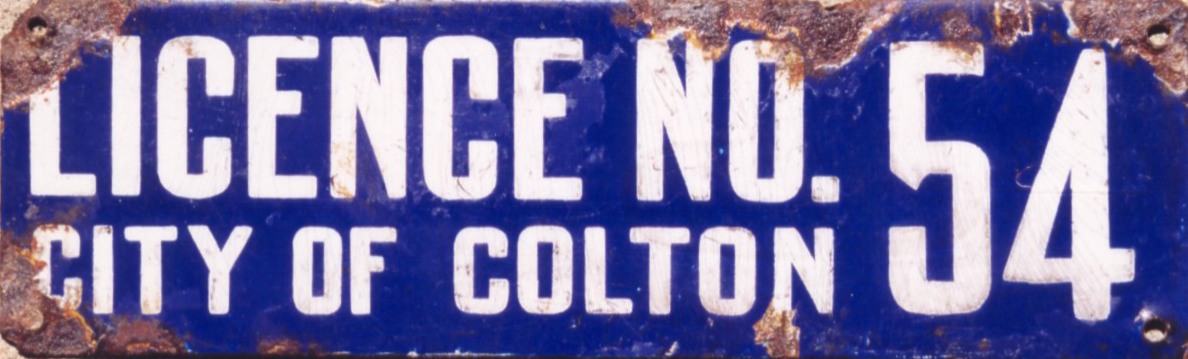
This mysterious plate is one we know virtually nothing about. There are two
surviving examples in collections today. Colton was a small town of about 4,000
residents in 1920. Its claim to fame is that two transcontinental railway lines - the
Union Pacific and Burlington Northern Santa Fe - intersect there. The junction is
one of the busiest at-grade railroad crossings in the United States. The Colton
plates are undated, but appear fairly old and may well have been used in the
teens. One of the most remarkable aspects of these plates is that they use the
non-American spelling of the word "license." Instead, the Colton plates read
"licence no." followed by the plate number. It is highly unlikely that these plates
were used as part of a general ordinance licensing vehicles in the city. Instead,
they were most certainly intended for use on some very specialized vehicle.
LONG BEACH
The Southern California community of Long Beach was home to about 50,000
residents in the late teens and early twenties. Like the Colton plates, Long Beach
plates are undated, but appear to be quite old, and could easily date from this
period. There are two known varieties of these large porcelain plates - plates
designed to license vehicles that carried lumber, and plates used on vehicles
that hauled junk. Both of these are highly unusual designations for porcelain
license plates. The lumber vehicle plates are the only example of a porcelain
license plate known from anywhere - state or locally issued - to use that term.
The junk collector plates are quite unusual as well, sharing the designation
"junk" with only Stamford, CT; Schenedtady, NY; and Clinton, MA in terms of that
word's usage on porcelain license plates.
LOS ANGELES
The only known plates from the city are motorcycle plates, which appear to have
been made of both flat painted metal and porcelain. They bear the distinguishing
curved format just as later state-issued cycles would adopt. Jeff Minard
estimates that these plates date from as early as 1909. Although these plates are
exceedingly rare, Los Angeles was of course, a huge city - the second largest in
the state and home to some 300,000 to 400,000 people in California's pre-state
period. There must have been thousands of motorcycles registered in the state
before 1914, and it is perhaps surprising that more surviving examples have not
shown up. Both surviving examples are entirely different from one another and
have numbers in the 3,000s, suggesting that there may have been a bloc of
numbers set aside for the registration of motorcycles. Of all the porcelain local
issues from California, the L.A. cycle plate is the only one dating to the pre-state
period.
SACRAMENTO
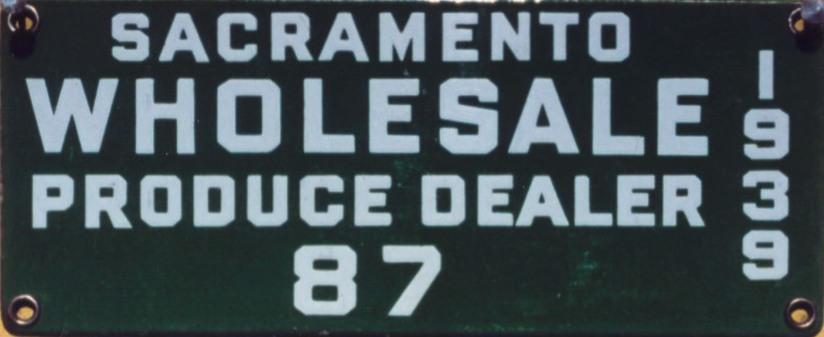
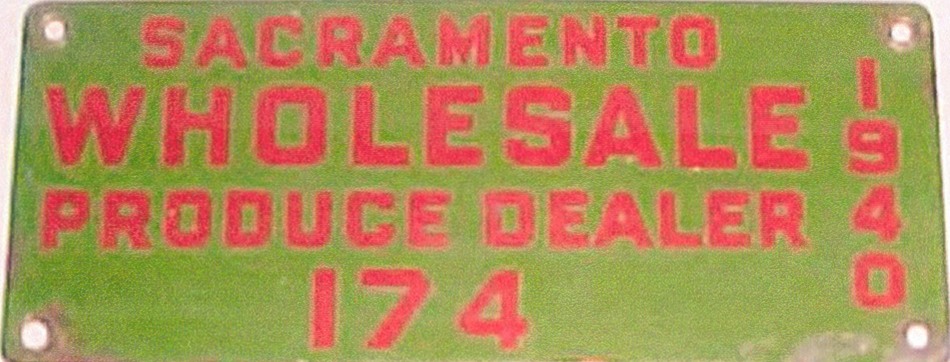
California's state capitol is not known to have produced porcelain plates prior to
the 1930s. When they finally decided to jump into the porcelain mix, they did so
with a series of plates intended to license produce dealers and wood & coal
dealers. These vary over the years - some of them have the city name while
others don't, some are numbered while others aren't, and they range broadly in
color schemes, including a very strange red & green Produce Dealer plate from
1940. The last known year is a Wood & Coal dealer plate from 1942. Sacramento's
run of porcelains stretching into the 1940s is notable because it joins only one
other city in the country - Providence, RI - as the sole jurisdictions issuing
porcelain plates at this late date.
SAN FRANCISCO
San Francisco was the most populous city in the state of California in the teens,
with some half-million residents. As a glance through the newspapers of the time
clearly shows, jitney buses were considered a growing nuisance in both San
Francisco as well as Los Angeles, and were causing a great many accidents and
injuries. As a result, jitney buses were soon regulated and licensed, thus
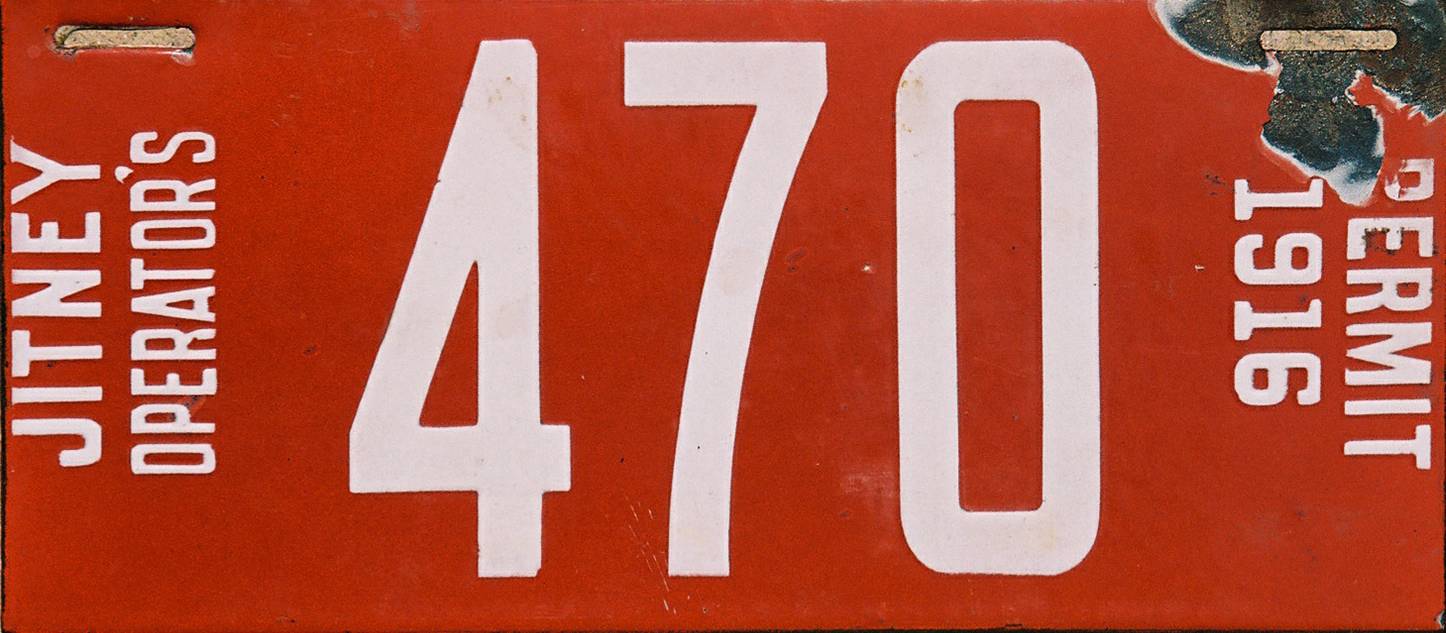
accounting for the known porcelain plates from San Francisco. There are two
porcelain jitney plates known, both dated 1916. Only one of them actually has the
city designation on it, and while it is conceivable that the other plate hails from a
different city, conventional wisdom is that they are both from San Francisco.
Since the one bearing the "S.F." abbreviation is designated for a "Class A" jitney,
perhaps the other one went on a "Class B" jitney - whatever that was.
Regardless, these plates are extraordinarily rare, with just one or two surviving
examples of each.
FIRE DEPARTMENT PLATES
California is distinctive for having a variety of numbered Fire Department plates
from various jurisdictions. These are a little outside of the parameters usually
covered on this website, but since they are numbered, they do technically qualify
as license plates as defined by www.porcelainplates.net , so I have included them
here more or less as an addendum.
I: PRE-STATES / CITY & COUNTY PLATES
California has a very rich history of porcelain pre-states, boasting some of the
most attractive and unique porcelains ever produced in any state. Although
California first required license plates to be used in 1905, all known varieties
over the first four years are made of metal, leather, wood, and other such
materials. As per the 1905 ordinance, plates were only required on the rear of
the car, although sometimes owners decided to put one on the front as well. As
California plate historian Jeff Minard has discovered, the switch to porcelain
seems to have occurred in 1909, when the Automobile Club of Southern
California, responding to growing pressure to force motorists to display plates on
the front as well as the rear of their vehicles, offered members porcelain Auto
Club “hangars” for their cars, loaning each of the Club’s 1,000 members free
plates. Interestingly, as indicated in paperwork enclosed in the shipment of
these plates, owners were told that these plates were the property of the Auto
Club and that if the motorist ceased to be a member, then the plates were to be
returned. Incidentally, it appears that some owners cut off the Auto Club
insignias - perhaps after dropping membership - leaving behind plates that are
often mistaken for simple rectangular pre-states. Auto Club plates for new 1909
registrants began around 20,000. Of course, lower numbers are known as well,
because the Auto Club provided whatever number a vehicle had registered to it.
For someone looking to have a pretty porcelain plate made to replace their
tattered leather plate from years earlier, they got a porcelain with that same
number, be it from 1905, 1906, or whatever. Between mid-1909 and the end of
the pre-state era in 1913, perhaps 4,000 Auto Club plates of all varieties were
manufactured. These plates carried the emblem of both the Auto Club of
Southern California, as well as the American Automobile Association. It is not
clear who manufactured these plates, but we know that at least some were made
by the California Metal Enameling Company and bear that company's paper label
on the reverse. It is also believed that the Pacific Sign & Enamel Company may
have produced some porcelain pre-states.
The Auto Club porcelains come with
various subtle differences, but can be
essentially broken down into eight
collectible varieties. The first three
concern the state’s famous and elaborate
“Mickey Mouse” plates, as they have
come to be known among collectors.
These plates have the Auto Club and Auto
Association emblems at the top. At some
point in the mid-80,000s, it is notable that
the numerals were altered to be thinner,
perhaps in order to accommodate the
six-digit plates which would soon be
arriving. The presence of low-numbered
plates with thin numerals would indicate
that they were replacement plates. A
substantially rarer variant has the "ears" on the bottom and itself comes in two
different formats. There are only two of these inverted plates known - one a five
digit and the other a six digit plate. There are at least two high-numbered Mickey
Mouse porcelains labeled on the reverse by the California Metal Enameling
Company. In fact, the numbers of these plates are the highest numbered Mickey
Mouse plates ever seen. Thus, we know that California Metal was producing at
least some of these plates in 1913, if not earlier as well.
The other five varieties concern the long and short versions of the “Dogbone”
porcelains, so known because they carried the Club emblems on the ends, as
opposed to the top or bottom. Specialists see even further subtle differences,
such as the presence of some dogbone plates with bolt holes, others with slots,
and still others with neither slots nor holes, but these are not generally
considered distinct types. The most unusual version of the “Dogbone” plates are
notable for having a flanged edge along the top and bottom. Some of these
flanged plates had black lettering, but the vast majority were manufactured with
blue letters and numbers. This makes them very distinct, as all other varieties of
Auto Club porcelains are black & white. Even more interesting, the blue & white
flanged plates come in two very distinct types - a long version with the right
circle bearing the term "Auto Ass'n" and a smaller version bearing the term "Auto
Ass."
The final two Dogbone types are the black
& white flat versions - a very long 24"
version and a relatively smaller 17 3/4"
variant which is further distinguished by
the fact that the "CAL" designation is
vertical rather than horizontal. As with all
Auto Club porcelains, some of these plates
have a dot between the words "Auto" and
"Club," while others do not. The presence
or lack of this dot, however, does not
seem to be tied to any particular variety.
Another interesting aspect of the long
flat dogbone is its length. Measuring in at
a full two feet across, these plates have
the distinction of being the longest
porcelain license plates of any kind known from the U.S. or Canada.
All Auto Club porcelains were issued in pairs, and could be ordered from the Auto
Club in a mix of styles. For instance, a "Dogbone" could adorn the back of a
vehicle, while a porcelain or even a metal screen version of a "Mickey Mouse"
could hang on the front.
In mid-1911, the Auto Club began issuing
plates to non-members, thus accounting
for the presence of porcelain California
pre-states without the Auto Club
designation on them. Newly registered
vehicles in 1911 got plates starting in the
50,000s. The most common variety of
these non-Auto Club porcelains are simple
rectangular plates. These come in a
plethora of subtle varieties - some with
corner holes, some with slots, some with
both and some with neither! However, it
terms of identifying collectible varieties,
most collectors would lump all of these
plates into one of two types - flat
rectangular plates and flanged rectangular plates. It is worth noting that there is
also one unexplained variant which has an "0" prefix and may have been a
sample, as the number is 06789, but this plate's precise usage is a mystery.
Finally, there are two other unique plates with odd shapes that look as though
they were modeled on the "Mickey Mouse" plates. We know nothing about these
porcelains, but they may not have been issued by the Auto Club.
California pre-states break down into the following year based on plate number:
In addition to California's rich history of pre-state porcelains, there are also a
number of locally issued porcelain plates from the state. With the exception of a
single variety - the undated curved motorcycle porcelains from Los Angeles - all
known California local issues are post-state issue. In addition, all of the other
city-issued porcelains from the state are special issues designed to license a
certain class of vehicle, be it a junk dealer, a produce dealer, a motorcycle, or a
jitney bus. Even in the largest cities, there were never any ordinances requiring
porcelain plates to be used on passenger vehicles. Instead, California local
issues are very obscure, rare, and little understood.
COLTON
This mysterious plate is one we know virtually nothing about. There are two
surviving examples in collections today. Colton was a small town of about 4,000
residents in 1920. Its claim to fame is that two transcontinental railway lines - the
Union Pacific and Burlington Northern Santa Fe - intersect there. The junction is
one of the busiest at-grade railroad crossings in the United States. The Colton
plates are undated, but appear fairly old and may well have been used in the
teens. One of the most remarkable aspects of these plates is that they use the
non-American spelling of the word "license." Instead, the Colton plates read
"licence no." followed by the plate number. It is highly unlikely that these plates
were used as part of a general ordinance licensing vehicles in the city. Instead,
they were most certainly intended for use on some very specialized vehicle.
LONG BEACH
The Southern California community of Long Beach was home to about 50,000
residents in the late teens and early twenties. Like the Colton plates, Long Beach
plates are undated, but appear to be quite old, and could easily date from this
period. There are two known varieties of these large porcelain plates - plates
designed to license vehicles that carried lumber, and plates used on vehicles
that hauled junk. Both of these are highly unusual designations for porcelain
license plates. The lumber vehicle plates are the only example of a porcelain
license plate known from anywhere - state or locally issued - to use that term.
The junk collector plates are quite unusual as well, sharing the designation
"junk" with only Stamford, CT; Schenedtady, NY; and Clinton, MA in terms of that
word's usage on porcelain license plates.
LOS ANGELES
The only known plates from the city are motorcycle plates, which appear to have
been made of both flat painted metal and porcelain. They bear the distinguishing
curved format just as later state-issued cycles would adopt. Jeff Minard
estimates that these plates date from as early as 1909. Although these plates are
exceedingly rare, Los Angeles was of course, a huge city - the second largest in
the state and home to some 300,000 to 400,000 people in California's pre-state
period. There must have been thousands of motorcycles registered in the state
before 1914, and it is perhaps surprising that more surviving examples have not
shown up. Both surviving examples are entirely different from one another and
have numbers in the 3,000s, suggesting that there may have been a bloc of
numbers set aside for the registration of motorcycles. Of all the porcelain local
issues from California, the L.A. cycle plate is the only one dating to the pre-state
period.
SACRAMENTO
California's state capitol is not known to have produced porcelain plates prior to
the 1930s. When they finally decided to jump into the porcelain mix, they did so
with a series of plates intended to license produce dealers and wood & coal
dealers. These vary over the years - some of them have the city name while
others don't, some are numbered while others aren't, and they range broadly in
color schemes, including a very strange red & green Produce Dealer plate from
1940. The last known year is a Wood & Coal dealer plate from 1942. Sacramento's
run of porcelains stretching into the 1940s is notable because it joins only one
other city in the country - Providence, RI - as the sole jurisdictions issuing
porcelain plates at this late date.
SAN FRANCISCO
San Francisco was the most populous city in the state of California in the teens,
with some half-million residents. As a glance through the newspapers of the time
clearly shows, jitney buses were considered a growing nuisance in both San
Francisco as well as Los Angeles, and were causing a great many accidents and
injuries. As a result, jitney buses were soon regulated and licensed, thus
accounting for the known porcelain plates from San Francisco. There are two
porcelain jitney plates known, both dated 1916. Only one of them actually has the
city designation on it, and while it is conceivable that the other plate hails from a
different city, conventional wisdom is that they are both from San Francisco.
Since the one bearing the "S.F." abbreviation is designated for a "Class A" jitney,
perhaps the other one went on a "Class B" jitney - whatever that was.
Regardless, these plates are extraordinarily rare, with just one or two surviving
examples of each.
FIRE DEPARTMENT PLATES
California is distinctive for having a variety of numbered Fire Department plates
from various jurisdictions. These are a little outside of the parameters usually
covered on this website, but since they are numbered, they do technically qualify
as license plates as defined by www.porcelainplates.net , so I have included them
here more or less as an addendum.
 |
| |
 |
| |
 |
| |
 |
| |
 |
| |
 |
| |
 |
|
Due to the size of the California archive, I have split it into two parts. Part 2 contains information on the following: II: STATE-ISSUED PASSENGER PLATES III: STATE-ISSUED NON-PASSENGER PLATES IV: ODDBALL PORCELAINS FURTHER READING CLICK HERE FOR PART 2 OF THE CALIFORNIA ARCHIVE |
Due to the size of the California archive, I have split it into two parts. Part 2 contains information on the following: II: STATE-ISSUED PASSENGER PLATES III: STATE-ISSUED NON-PASSENGER PLATES IV: ODDBALL PORCELAINS FURTHER READING CLICK HERE FOR PART 2 OF THE CALIFORNIA ARCHIVE |
California "Mickey Mouse" Pre-state
|
|
|
|
|
|
|








Unique pairing of a regular set of "Mickey" plates with a single inverted version. |

Unusual zero prefix pre-state. Could this be a sample? |

| For a photographic census of known "Mickey Mouse" porcelain pre-states, click HERE. |
|
|
|


| California "Dogbone" Pre-state Courtesy of the L.A. Public LIbrary |
|

| Examples of mixed variety pairs of pre-states |
| Although none of these variants is significant enough to warrant being considered a collectible type by anybody other than an ultra-specialist, it is interesting to note the plethora of corner and slot hole differences that exist on the rectangular California pre-states. |


| Corner & Slot holes |
| Corner holes only |
| No corner or slot holes |
| Slot holes only |


| California Pre-state |
